|
|
09/22/2015 RIAN DE JONG:
FOUND AT ... MADE IN ... Gallery Loupe,
Montclair, New Jersey,
USA By Susan Cummins
Rian
de Jong's show at Gallery Loupe consists of photographs of landscapes where the jewelry was made, as well as the jewelry itself. Rian
is an interesting artist not only because she works
with interesting materials and processes, but also because of where she works-on a sail boat. I asked her about the relationship between the two. Susan Cummins: Rian, you are the only jeweler I know who makes their work on a boat, so I am tempted to ask you more questions about your life on a boat than I am to ask about your jewelry, but I will try to do some of both! Let's start with how you became interested in making jewelry. Where were you born? Where did you go to school? Who were your professors? Rian de Jong: Yes, it is quite rare that a professional
sailor makes jewelry, or for a professional jeweler to sail most of the time.
In my case I am able to combine both. Ever since 1985, when I left Amsterdam
in a sailboat to stay the winter in Portugal, I have been sailing and making
jewelry. On that first trip we proceeded to Turkey and spent the season
sailing with paying guests. Starting in 1977, my husband, Herman, and I did
that for several years and then in winter we would both work very hard.
Herman earned money for the next season while my hands were itching to make
new series and exhibitions. I was born on a farm in the Gouda area, cows,
making Gouda cheese at home, eight siblings, and not much time for every
individual child. Nevertheless, I had a happy childhood, carefree. I always
knew that I wanted to study at an art academy, but it took some wanderings to
get so far. I studied sculpture at Gerrit Rietveld Academy and the jewelry
department was next door. In the jewelry department, I got acquainted with
particular studies and processes that could lead to jewelry in the end. I fell in love with it and changed disciplines
after studying sculpture for three years. Marion Herbst was my professor,
Joke Brakman, a few other professors and
guest-teachers all tried to get our souls into the process of making things.
The last two years at the academy I shared a studio in an old hospital with a
friend. It was a place where artists squatted (very Dutch). I was able to
work in the attic since no one had discovered this space. There, I was able
to work on both larger- and smaller-scale work, and so I graduated in
sculpture and jewelry.
When did you start sailing? Rian de Jong: In Holland we are used to water.
When I was about 12 years old, I was taken by friends of my parents on their
sailboat. It was a very primitive one without an engine, so we had to tack on
the lake by sitting first on one side, then switching to the other side. We
were busy as hell, but it was so much fun. I loved it, the wind, the smell of
the lake, which is so different from the sea. This was about 50 years ago.
Beginning in 1979, I started to sail on a more professional scale. On a
typical Dutch barge we sailed to the Baltic and on to Leningrad when Brezhnev
was still in power. Since that time, the technology has developed so
much that for instance now we don't need to steer anymore. We can follow the
course on the computer and adjust it when needed with the + or - button. With
AIS we can see other ships on the chart and get a warning when they are
coming too close, or when courses are crossing. The autopilot is our third
man who is never tired, never has to eat, and never takes a nap.
How often do you leave Amsterdam, and how long do
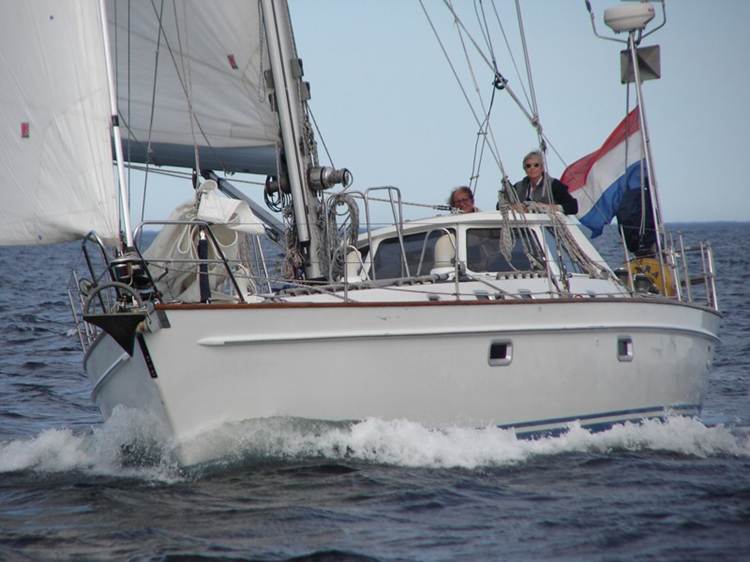
you usually stay away? What keeps you sailing for long periods of time? Rian de Jong: When we left Amsterdam in 2007, the
plan was to go around the Americas. We didn't want to go around the world and
follow the easy route to Panama and the Pacific with the wind at our backs.
We had already sailed with our big schooner to Thailand. We are more
adventurous and had the urge to take a more unknown path. The path was
"there where the crowd isn't going:' We didn't know when we would be
going back home, so we just left. When we would return was the least
important. We stopped in Greenland, New York was our winter
base, Newfoundland, the Caribbean, Brazil, Uruguay, Argentina, Antarctica,
and Chile followed. After a few years, we learned that we should go back to
Amsterdam now and then in order not to lose our friends and to see our
family. Their lives go on like yours, and you have to keep in touch by being
there. Also, when living on board all the time, you don't see it as special
anymore. So for these reasons we go home more often and for longer times.
Sometimes it is not possible because you have to sail in a particular season
when the wind and current are favorable. The boat can stay in most countries
for a maximum of two years, and then we have to move on. Sailing is slow when you are crossing a few
thousand nautical miles. You need time and often have to wait for better
weather, or you need to make repairs or have a rest and visit the country.
"Meeting people" is our main theme. The shortest stay on the boat
is about six months; the longest time, a year and a half. The boat has become
more our home than our house in Amsterdam, and the world is our playground.
[right] Rian de Jong, photo: artist From the beginning did you make jewelry onboard,
or was that a later development? What is your studio like on the ship? What
equipment do you have? I imagine that you are quite busy onboard, so when do
you find the time to make it? Rian de Jong: With guests on board I was not able
to make jewelry. I made photos and tried to collect material and thoughts to
work on in winter. On our trip around the Americas I could work on board. In
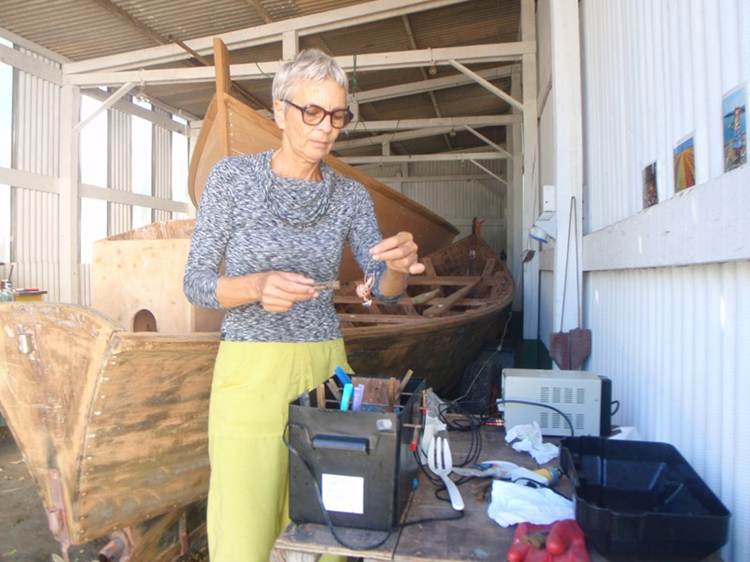
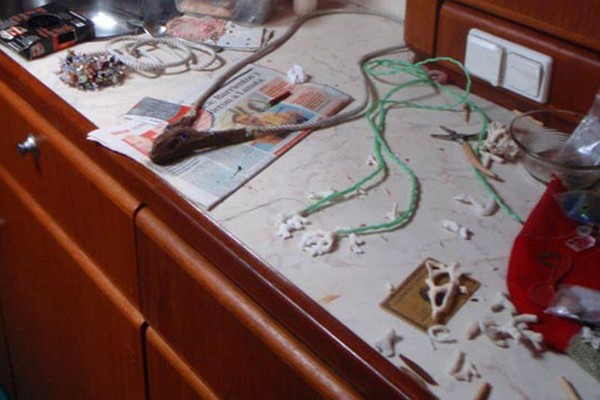
a tiny cupboard I have some materials and the most elementary equipment, like
pliers, a saw, a hanging drill, and my electroforming tank. It is quite
something to store a few liters of sulfuric solution on board near saltwater,
since the mix is very explosive and poisonous. While sailing it is better not
to work; the acid bath moves and goes in all directions. On long stretches,
it's not that busy, you just have to keep an eye open, so then I'm able to
sketch with modeling wax to keep things in mind, but most of the time I am
too tired while we are sailing. We have watches, four hours up, four off at a
time. Just when you feel you could do something, you have to go to bed again.
Most of my work is done while waiting for the right time to leave someplace.
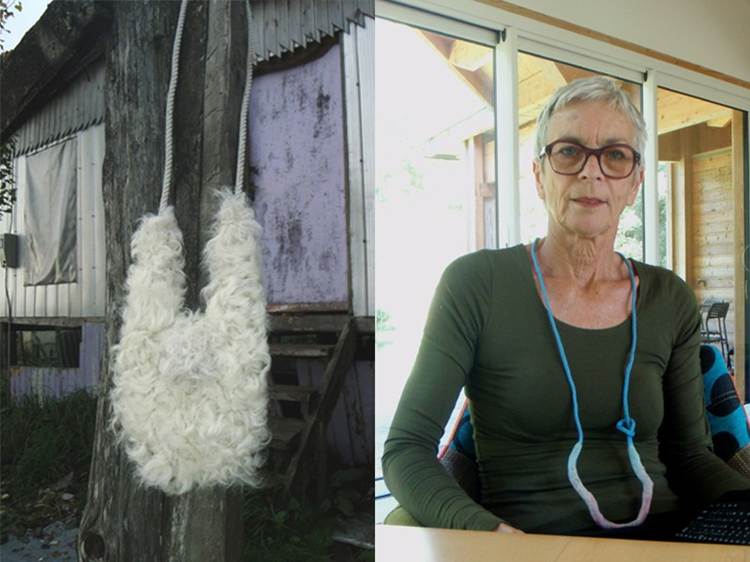
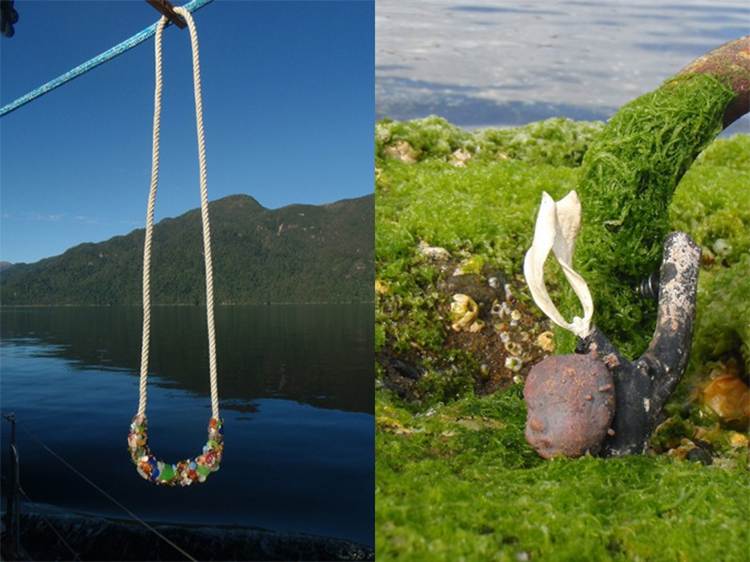
neckpiece, beads, rope, 580 x 100 x 40 mm, photo:
artist [right] Rian de Jong, Found at:
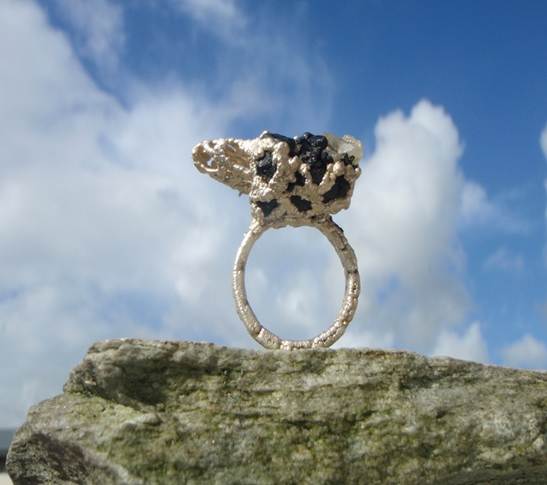
Mediterranean/Made in: Amsterdam, 2015, brooch, black coral, copper, silver, 70 x 60 x 20
mm, photo: artist This latest work in the show at Gallery Loupe
called Found At ... Made In ... is very much the combination of your travels
and your jewelry. Please describe how the show combines the two. Rian de Jong: The nature of the materials indicates
that it is not made behind a bench in a studio. I used a number of nautical
ropes from the ship to make jewelry. They were used for another purpose on
board, so you can see some wear and tear on them, which makes it more vivid
for me, but it makes me unpopular with the captain (Herman doesn't much like
my stealing since every rope is important). In the gallery, there will be big photos of some
pieces in a landscape to show the site-specific places. The show will be
accompanied by a catalog, which shows the Chilean channels, little Caletas,
the vast Andes, and the only settlement within 2,000 nautical miles. It
documents the atmosphere, the places, and the process of making the jewelry.
In the images, you can see that these are not places you just fly to for a
leisure moment.
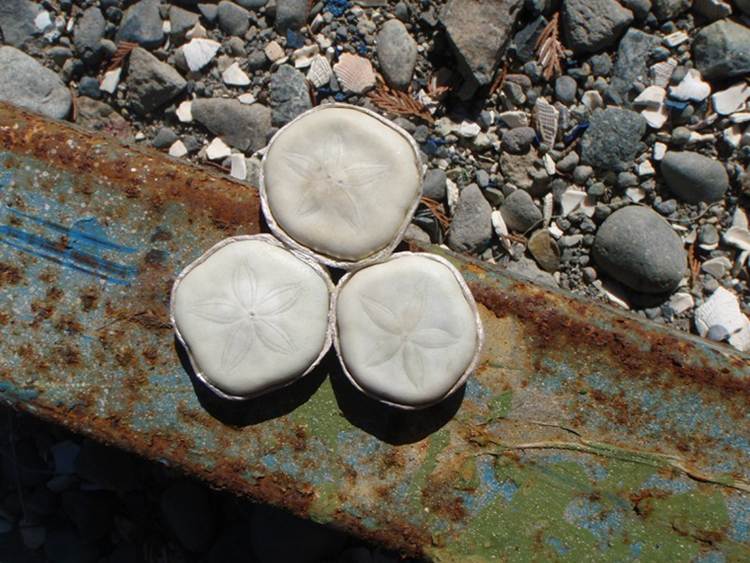
Rian de Jong, Found at: Sea/Made in: Amsterdam,
2015, brooch, sand dollars, silver, 70 x 70 x 6 mm, photo: artist You are using so many different kinds of material
in your jewelry that I wonder how you decide to use one instead of the other.
If everything is fair game, how do you choose? Rian de Jong: I am not so much choosing a
material as just letting it appear. I have always worked like this. Some
friends even collect things they think will be special for me. In a series,
like the one at Loupe, I am in a special mood, which makes me look at the
things around me in a particular way. I have never chosen to use things from
the boat since it is so obvious, but then look what happened when I took
Herman's ropes! And now they are part of the jewelry. How did that happen?
Your brain has a system to choose, I guess, and you have nothing to say about
it. I'm not complaining. Your hands just follow the brain and it works. We were stopped for eleven stormy and rainy days
at Brecknock Bay, and one day I came for a glass of wine and Herman smiled at
me and said : "I see the Rian of the end of the 80s. It
seems you are doing well. Your way of working and your emotional approach
looks pretty much like it did when you were making the wooden work back then”.
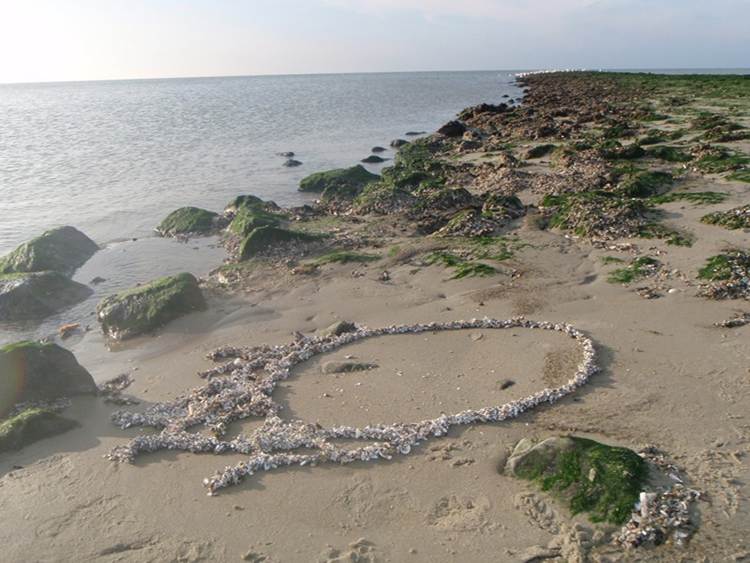
Rian de Jong, Found at: Texel, The
Netherlands/Made in: Amsterdam, 2015, object, broken shells, 1200 cm x 650 cm x 30 mm,
photo: artist Do you think you are following in the footsteps
of earlier Dutch sailors? Rian de Jong: When you think of trade, no. When
it comes to piracy, no. When it is about adventure, yes. When it is about
finding a new world, yes. I want to learn the particulars of a country. I
want to be there long enough to have an idea how it works, to meet people and
learn their special habits. Our boat is just a vehicle, we can use it to move
us in a very special way, but the important thing is to arrive somewhere. Can you tell us some of your seafaring adventures?
Maybe something really exciting or scary. Rian de Jong: The most recent scary and very
uncomfortable time was in the Drake Passage between Antarctica and Cape Horn
in 2014, where we had to "heave to" at the most miserable place on
Earth. The predicted storm came on much quicker than expected by the NOAA
weather forecast. For days we had calculated the right time to leave
Antarctica, but still that's always a guess. So we were caught in it and had
to wait 3 days in order to avoid crossing to Cape Horn in perilous
conditions. It would have been easy not to survive it. Going back was no
option since we would run into another storm. After three days, we were just
like scrambled eggs! The really exciting things are entering a city
like Rio de Janeiro. For days you are at sea, and then suddenly there it is.
You enter between these high rocks and there is this famous city in front of
you. On your left is the Corcovado with the sculpture of Cristo Redentor! We had the same feeling when we entered our first
big city: New York with the Statue of Liberty. It takes five months of
sailing from Amsterdam, whereas a plane would normally take just six hours.
The joy, the unexpectedness, the really being there, and what you feel can't
be described in words. Sailing away to explore a new part of the world,
raising the sails, feeling the air with only the noise of the wind, wow, that
is life.
What do you miss most about sailing and the sea
when you are home? Rian de Jong: Actually, nothing. That sounds
strange for a sailor, but that might be due to the knowledge that in a few
months I will be there again. It is not only fun the way you would imagine,
but it is also hard work. It is top sport, and more than just the sailing
itself. Everything on board will stop working at one time or another, and so
then you have to analyze what is wrong and find a solution to repair it. Most
times you are at a place where there are no shops or they don't have what you
are looking for. The interaction between sailing, enjoying, and working is
okay when it is in balance, but is frustrating when it is not. After so many years at sea, we want to retire
now. It's wise to stop this extensive kind of sailing before you are 70.
We'll start a new life by traveling through Europe with our recently
purchased 1986 VW-T3 Transporter bus. We will sail Lyra the coming year(s)
via Papeete, Hawaii, Kodiak, to Seattle Vancouver in the hope that we will
find new lovers for her there. We also bought a new "ship" ashore
in the south of France. A beautiful very modern (kind of Frank Lloyd Wright)
wooden house with portholes, with no external delivered energy, solar panels,
and heating with wood from the forest. So with the sale of Lyra (yes, she is
for sale), we will start a new traveling life on more fixed ground. You even
can see the first results of this new inspiration source at the show in
Montclair, two pieces made in the south of France. What have you been reading or seeing lately that
you would like to recommend? Rian de Jong: Every we year try go to Oerol, an outdoor theater/art/music festival on Terschelling, one of the islands in the north of Holland.
I recommend this to everyone. It is an explosion of creativity all over the
island, at the beach, the dunes, farmers' sheds, in the woods, and you bike
from one to the other in all weather. It is quite an intensive week, and at
the end we are exhausted, but with a rich feeling to take back home. I just finished The Fountainhead,
by Ayn Rand. It was written in the 30s and is about culture, creating, and
manipulation. The play has just been in Amsterdam, but I was not able to
attend, so I liked reading the book very much. Thank you. AJF has decided to begin posting the
prices of pieces in the gallery shows we are highlighting each month. The
prices in this show ranged from $1500 to $1700. |
|